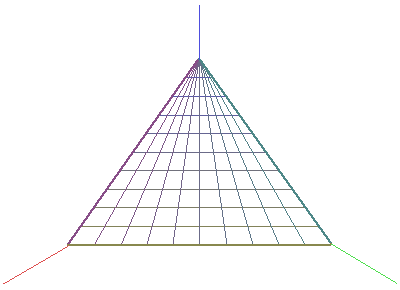
Introduce a new variable w=y/x, and slice the region along lines with w=constant and z=constant, as shown. Starting from dr=dxi+dyj+dzk and using the equation of the surface, x+y+z=1, we have dr1=(i−j)dx along z=constant lines, and dr2=(−i/(1+w)−wj/(1+w)+k)dz along w=constant lines. After some algebra, one obtains dr1=(j−i)(1−z)/(1+w)2dw, leading to dA=dr1×dr2=(i+j+k)(1−z)/(1+w)2dwdz. Dotting this with the given vector field E=zk yields z(1−z)/(1+w)2dwdz, and integrating this as w goes from 0 to ∞ and z goes from 0 to 1 yields 1/6.
(Note that the limits are constant. The infinite limit can be removed by replacing w by tan(φ).)
Next