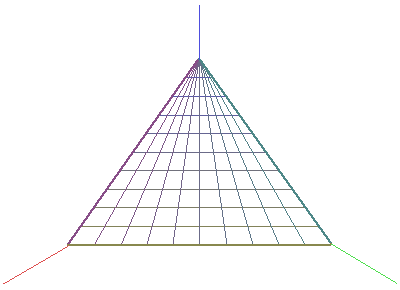
This slicing also lends itself to the use of cylindrical coordinates, in which dr=drr+rdφφ+dzz. In these coordinates, the equation for the surface becomes r(sinφ+cosφ)+z=1. If z=constant, this implies (sinφ+cosφ)dr=(sinφ−cosφ)rdφ, so that dr1=[(sinφ-cosφ)r/(sinφ+cosφ)+φ]rdφ. If φ=constant, (sinφ+cosφ)dr+dz=0, so that dr2=[−r/(sinφ+cosφ)+z]dz. Thus, dA=[…+z/(sinφ+cosφ)]rdφdz. Dotting this with the given vector field E=zz yields [(1-z)zdz][dφ/(sinφ+cosφ)2], and integrating this as φ goes from 0 to π/2 and z goes from 0 to 1 yields 1/6.
(The φ integration is most easily done in terms of tan(φ).)
Return