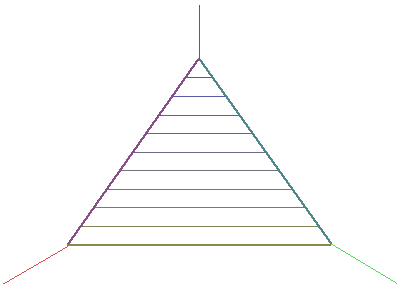
Since the given vector field depends only on z, slice the triangular region into strips along lines with z=constant, as shown. The vector displacement along each such line is j−i at the base, and has a magnitude which varies linearly with height; this vector displacement is therefore (j−i)(1−z). The slant height between nearby slices is dr=dxi+dyj+dzk which reduces to dr =(−i/2−j/2+k)dz since x=y=(1−z)/2 up the middle. The (upwards-oriented) area vector for a single strip is therefore the (cross) product of these (perpendicular) vectors, namely dA=(i+j+k)(1−z)dz. Dotting this with the given vector field E=zk yields z(1−z)dz, and integrating this as z goes from 0 to 1 yields 1/6.
(The slant height [really dr] does not need to be taken up the middle so long as the cross product is used. Alternatively, the argument up the middle can be recast without vectors at all.)
Return