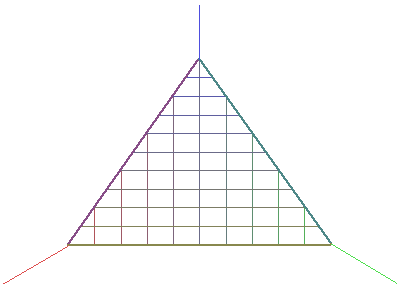
Introduce new variables u=(x+y)/2, v=(x-y)/2. Then u=constant along lines with z=constant, since the equation of the surface becomes 2u+z=1, and v=constant along the perpendicular lines. As always in rectangular coordinates, we start from dr=dxi+dyj+dzk. Along lines with v=constant, we have dy=dx=du=dz/2, so that dr1=(i+j−2k)du. Along lines with u=constant, we have dy=−dx=dv (and dz=0), so that dr2=(j−i)dv. Thus, dA=dr1×dr2=2(i+j+k)dudv. This is the same result as before! But we have carefully replaced x,y with u,v, and the limits are now easy. Dotting with the given vector field E=zk yields 2(1−2u)dudv, and integrating this as v goes from −u to u, then as v goes from 0 to ½ yields 1/6 as expected.
Return