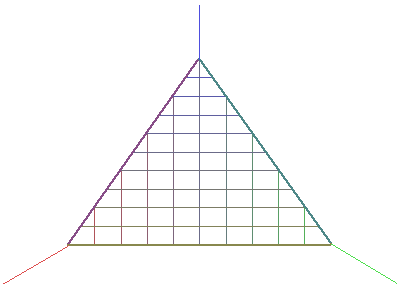
Slice the region along lines with z=constant, then along lines perpendicular to these, as shown. Starting from dr=dxi+dyj+dzk and using the equation of the surface, x+y+z=1, we have dr1=(j−i)dx along z=constant lines. To be perpendicular, the remaining lines must satisfy dx=dy, which leads to dr2=(i+j−2k)dy so that dA=dr1×dr2=2(i+j+k)dxdy. Dotting this with the given vector field E=zk yields 2(1−x−y)dxdy. But what are the limits of integration? If we naively project into the floor (compare the traditional solution), we get the wrong answer. What is going on?
Next